
The Indian automobile industry is a global leader, ranking as the third-largest in passenger vehicles and heavy trucks, and the largest in two-wheelers. Contributing over 7% to India’s GDP, the sector is experiencing record growth in SUVs and a rapid shift toward electric vehicles (EVs), with a projected market valuation exceeding $160 billion by 2027.
Importance of the Automobile Industry in India
The Indian automobile industry is one of the most important sectors of the country’s economy and is often considered a key indicator of economic performance. The sector contributes significantly to industrial growth, technological development, and employment generation. Because of its strong connection with manufacturing, logistics, and services, the performance of the automobile industry reflects the overall health of the economy.
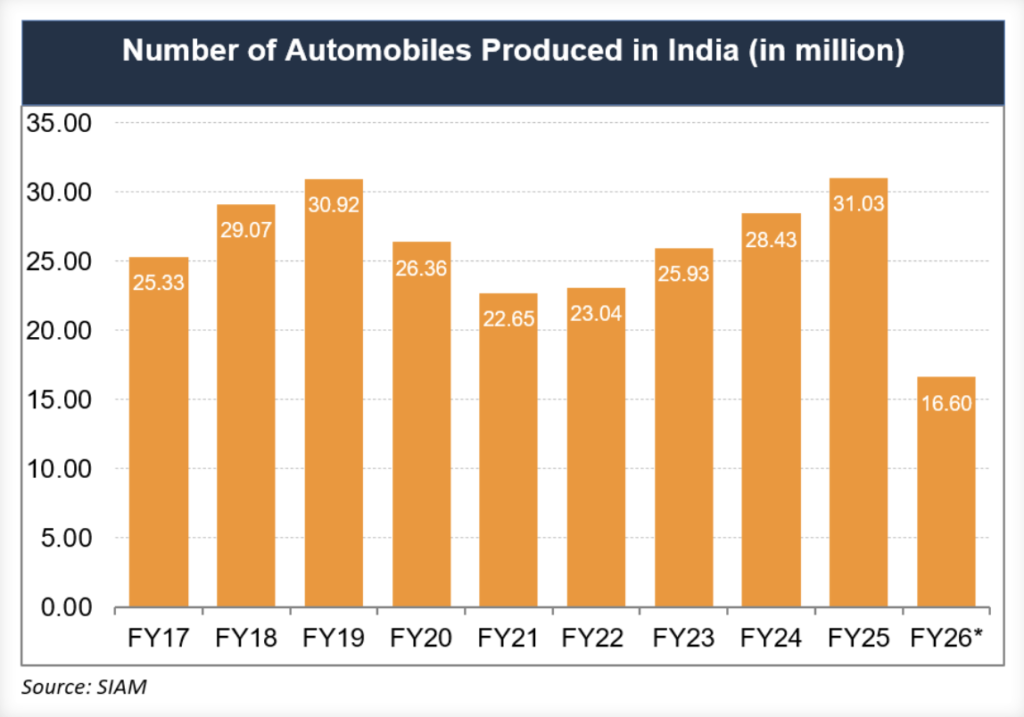
Two-Wheeler Segment Dominates the Market
Within the automobile sector, the two-wheeler segment dominates in terms of volume. This growth is mainly driven by a large young population, a growing middle class, and rising demand from rural areas. Two-wheelers are affordable and convenient, making them the preferred mode of transport for millions of Indians.
At the same time, commercial vehicle demand has also increased in recent years. The expansion of logistics services, e-commerce, and passenger transport has supported the growth of trucks, buses, and other commercial vehicles.
Emerging Trends: Electric Vehicles
One of the biggest trends shaping the future of the automobile industry is vehicle electrification. Electric mobility is growing rapidly, especially in three-wheelers and small passenger vehicles. The shift toward electric vehicles is being driven by government policies, environmental concerns, and rising fuel prices.
India’s Strong Position in Automobile Exports
India has also become a major exporter of automobiles. In FY25, automobile exports increased by 19%, crossing 5.3 million units. This growth was mainly supported by strong global demand for passenger vehicles, two-wheelers, and commercial vehicles.
Government initiatives such as the Automotive Mission Plan 2026, the vehicle scrappage policy, and the Production Linked Incentive (PLI) scheme are expected to further strengthen the sector and help India emerge as a global leader in automobile manufacturing.
India’s Global Leadership in Heavy Vehicles
India holds a strong position in the global heavy vehicle market. The country is currently the largest tractor producer in the world, the second-largest manufacturer of buses, and the third-largest manufacturer of heavy trucks.
In October 2025, the total production of passenger vehicles, three-wheelers, two-wheelers, and quadricycles reached around 2.8 million units.
Market Share in the Domestic Automobile Sector
The domestic automobile market in India is dominated by two-wheelers and passenger vehicles.
- Two-wheelers: 77.87% market share
- Passenger vehicles: 15.60% market share
During FY26 (April–September 2025), passenger car sales were mainly driven by small and mid-sized cars, which remain the most popular choice among Indian consumers.
Electric Vehicle Market: A Major Growth Opportunity
The electric vehicle (EV) market in India is emerging as a major growth driver for the automobile industry. India achieved an important milestone with the sale of 1,00,000 EVs in 2024, compared to 82,688 units in 2023.
A study by the CEEW Centre for Energy Finance estimates that the Indian EV sector could create a US$206 billion opportunity by 2030. To support this growth, around US$180 billion investment will be required in vehicle manufacturing and charging infrastructure.
EV Financing and Battery Market Growth
According to NITI Aayog and the Rocky Mountain Institute (RMI), India’s EV financing industry could reach US$50 billion (₹3.7 lakh crore) by 2030.
Meanwhile, the India Energy Storage Alliance estimates that:
- The EV market will grow at a CAGR of 36% between 2018 and 2026.
- The EV battery market will expand at a CAGR of around 30% during the same period.
Future Outlook
With strong domestic demand, rising exports, supportive government policies, and rapid adoption of electric vehicles, the Indian automobile industry is expected to continue its strong growth in the coming years. The sector is likely to play a key role in shaping India’s manufacturing strength and global competitiveness in the future.
Government Initiatives for Automobile Sector
- The Government of India encourages foreign investment in the automobile sector and has allowed 100% FDI under the automatic route. Some of the recent initiatives taken by the Government of India are:
- On August 26, 2025, India’s EV push included 14,028 e-buses, 9,332 public charging stations, and over Rs. 54,000 crore (US$ 6.32 billion) in investments through PM E-DRIVE and PLI schemes to boost domestic manufacturing and green mobility.
- PM E-DRIVE, started in October 2024, is India’s umbrella scheme to accelerate EV adoption and ecosystem support with a Rs. 10,900 crore (US$ 1.31 billion) outlay, encompassing e-2Ws, e-3Ws, e-buses, heavy EVs, public charging infrastructure, vehicle testing, and localisation, with its tenure extended to March 31, 2028.
- Under the upcoming CAFÉ 3 norms, effective from April 2027, India will place electric vehicles and flex-fuel vehicles which use ethanol-petrol blends on equal regulatory footing.
- As of July 31, 2025, India has advanced EV adoption through FAME-II, PM E-DRIVE, and PM-eBus Sewa, committing over Rs. 42,000 crore (US$ 4.91 billion) towards incentives, infrastructure, and localisation across vehicle segments and regions.
- The Ministry of Heavy Industries has launched FAME- III Scheme, with a budget of Rs. 10,900 crore (US$ 1.29 billion) to promote electric mobility and reduce reliance on fossil fuels over a two-year period from April 1, 2024, to March 31, 2026.
- Under Electric Mobility Promotion Scheme 2024 government aims to support 3,72,215 EVs including e-2W (3,33,387) and e-3W (38,828 including 13,590 rickshaws & e-carts and 25,238 e-3W in L5 category).
- Ministry of Heavy Industries, Government of India with the approval of Department of Expenditure has launched Electric Mobility Promotion Scheme 2024 to further accelerate the adoption of EVs in the country which is a fund limited scheme with a total outlay of Rs. 500 crore for the period of 4 months, from 1st April 2024 to 31st July 2024.
- In January 2024, the Ministry of Heavy Industries extended the tenure of the Production Linked Incentive (PLI) Scheme for Automobile and Auto Components by one year. The incentive will now be applicable for a total of five consecutive financial years, until March 31, 2028.
- Ministry of Heavy Industries (MHI) officials revealed that India plans to launch a new scheme to incentivise electric vehicle purchases and improve charging infrastructure, aligning with the interim budget’s focus on eco-friendly transportation. Also, the allocation of US$ 321.5 million (Rs. 2,671.33 crore) for 2024-25 is expected to be utilized by March 31, 2024.
- Under phase-II of FAME India Scheme, subsidy amounting to US$ 696.8 million (Rs. 5790 crores) has been awarded to EV manufacturers on sale of 13,41,459 number of electric vehicles till January 31, 2024.
- The FAME Scheme was extended for a further period of 2 years up to 31st March, 2024
- In January 2023, under the FAME-II scheme, the Centre approves US$ 97.77 million (Rs. 800 crore) for 7,432 public fast charging stations.